

Technology and Innovation: Uruguay’s Digital Metamorphosis
Uruguay stands at a pivotal crossroads. The nation has built a solid foundation of democratic stability, progressive social policies, and environmental leadership, yet its economic growth has plateaued below the levels required to reach true developed nation status. The next chapter of Uruguay’s story must be written in the language of innovation, where technology becomes not just a sector, but the transformative force that elevates every aspect of national life.
The Challenge and the Opportunity
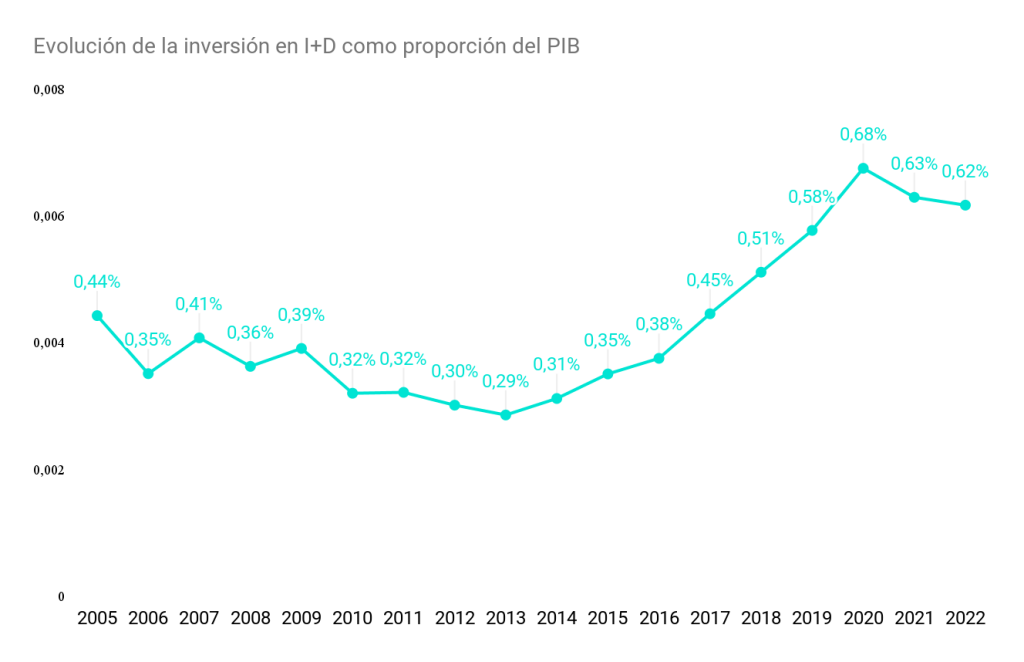
Uruguay’s current investment in research and development tells a sobering story. At just 0.44% of GDP, it lags behind both developed nations and the Latin American average. This underinvestment fuels brain drain, limits high-value exports, and keeps the economy dependent on traditional sectors.
Yet within this challenge lies Uruguay’s greatest opportunity. The nation possesses the human capital, institutional quality, and strategic position to become Latin America’s next innovation powerhouse.
Evolution of R&D investment compared to national GDP:
Building the Foundation: Investment and Infrastructure
To spark transformation, Uruguay must commit boldly to research and development. A clear target: investing at least 1% of GDP by 2030, advancing toward the 2–3% range typical of innovative economies.
Private participation is crucial. Tax incentives for R&D, innovation vouchers for SMEs, and partnerships between universities and industry will drive this shift.

Smart cities can be another frontier. Montevideo and other urban centers could become living laboratories where sensor networks optimize traffic, energy, and public services in real time. Uruguay’s compact geography makes it ideal to pioneer these solutions and export them across the region.
With over 90% of its electricity from renewables, Uruguay is also primed to lead in green technologies, developing expertise in energy storage, smart grids, and sustainable industrial processes.

+COLONIA
Cultivating Talent: Education for Innovation
Technology without talent is merely equipment.
Uruguay’s educational transformation must match its technological ambitions. The country has led in digital inclusion—now it must elevate STEM education as a mindset, not just a subject.

Curricula should integrate creativity, computational thinking, and adaptability. Technical education deserves prestige and investment, linking directly to high-quality careers in emerging sectors.
Universities must evolve into innovation engines, connecting research with industry and national priorities.
To retain and attract talent, Uruguay must create world-class research careers, modern facilities, and meaningful projects. Initiatives to bring back the diaspora and attract foreign researchers can inject global perspectives into the innovation ecosystem.
Becoming a Regional Tech Hub
Uruguay’s stability, education, and location make it ideal to become Latin America’s premier technology hub; A base for international firms seeking reliability, rule of law, and quality of life.
Strategic sectors where Uruguay can lead:
- Biotechnology, building on agricultural research and institutions like Institut Pasteur de Montevideo.
- Fintech, leveraging Uruguay’s strong financial system for blockchain, digital payments, and financial inclusion.
- Climate technology, creating exportable solutions in water management, sustainable farming, and disaster prediction.
Digital Governance and Civic Innovation
Digital government must reimagine the relationship between state and citizen. Secure digital identities, transparent blockchain systems, and AI-assisted policymaking can make governance more efficient and accountable.
Connectivity and inclusion are non-negotiable. High-speed internet and digital literacy are now as essential as electricity. Citizen participation platforms; budgeting tools, co-creation spaces, and transparent dashboards can deepen democracy and trust.
The Circular Innovation Economy
Uruguay must innovate sustainably. Instead of copying resource-intensive industrialization, it can pioneer a circular economy driven by technology: zero-waste production, long-lived products, and digital platforms for reuse.

Precision agriculture using sensors, AI, and drones can optimize water use and yields. Vertical farming and climate-adapted crops can secure food supply while reducing emissions.
Industry 4.0 technologies—robotics, additive manufacturing, advanced analytics—allow small-scale, high-value production aligned with environmental responsibility.
International Cooperation and Knowledge Networks
No country innovates alone. Uruguay must integrate into global knowledge networks through partnerships, conferences, and scientific cooperation. It should pursue selective excellence focusing resources on domains where it can lead globally.
Regional cooperation can position Uruguay as a bridge between South America, North America, and Europe, hosting research hubs and regional innovation events that elevate the continent’s capabilities.
Financing the Future
Innovation needs capital. Uruguay should nurture venture funds, angel investors, and public-private partnerships to finance high-risk, high-reward projects.
International development banks and impact investors increasingly seek sustainable opportunities; Uruguay’s stability makes it an ideal destination.
Banks must also adapt, learning to evaluate knowledge-based ventures. Alternative instruments, crowdfunding, innovation bonds, revenue-based financing can complement traditional credit.
The Path Forward
True transformation requires political will beyond election cycles.
Uruguay should elevate innovation policy to a national priority, guided by an independent Innovation Council linking government, academia, business, and civil society.
Regular evaluations against international benchmarks will ensure transparency and progress.
By 2036, Uruguay could stand as proof that small nations can thrive in the knowledge economy—where technology serves human development, not replaces it; where innovation and sustainability reinforce one another.
This is the metamorphosis Uruguay must pursue: not abandoning what makes it distinctive, but amplifying it through innovation.
The future is not predetermined, it’s built by the choices made today.

Explore other topics in detail:


URUGUAY2036
Uruguay2036 is an educational research project. Content is based on publicly available sources (see sources) and is for informational purposes only.
Pages

Uruguay2036 – Beyond Possible